



Headington is older than Oxford itself.
One tiny bone of contention that tends to raise some eyebrows: Headington was a long-established settlement when central Oxford was still, in the words of local historians, "little more than a bog."
While what would one day become the city below was still marshland beside the Thames, the dry, sandy soil of the hill above was already somewhere people going about their daily lives called ‘home’.
Excavations carried out in Barton Lane in 2001 uncovered evidence of Bronze Age habitation dating to around 1000 BC, and Iron Age pottery found at the Manor Ground suggests a settlement at that site by around 600 BC.
By the 4th century, Roman Britons had established a pottery works here. One of their kilns can still be seen today in the Museum of Oxford. Then came the Anglo-Saxon period, and burial remains from around AD 500 add to the historical picture.
The very name tells you something. Headington derives from the Old English Hedena's dun – or "Hedena's hill" – a name given in Saxon times when the ridge above the Thames valley served as a palace or hunting lodge for the Kings of Mercia.
In the year 1004, King Æthelred the Unready signed a royal charter "written at the royal ville called Headan dune," granting land to St Frideswide's Priory in Oxford. In 1086, the Domesday Book records, simply but grandly: Rex tenet Hedintone: "The King holds Headington."
Headington Absorbed
For most of its history, Headington remained very much separate from Oxford. Linked to it, certainly; administered by it. Served by it, and at its service. Nevertheless, distinct.
The city of Oxford grew up around its university down the hill, but the villages of Old Headington, Headington Quarry and Barton kept their own character and their own rhythms.
The eventual absorption happened in stages, and not without some administrative complexity. In 1868, the western edge of the parish around Headington Hill was folded into the Oxford parliamentary constituency. By 1889, that same area was formally added to the city and municipal borough. But the original villages – the historic heart of Headington – held out until 1929, when the civil parish and urban district of Headington was finally dissolved and absorbed into the City of Oxford.
In fact, it had been an ‘urban district’ for only two years by that point, having shed its rural district status in 1927. In many ways, the pace of change was characteristically English: gradual, procedural… and involving a lot of paperwork.
By the time Headington became part of Oxford, housing was already spreading rapidly around the medieval village core. The suburb that most people recognise today was largely a product of the early and mid-twentieth century – though beneath its more modern streetscape, we can all feel that something far older lies beneath.
Headington: a place of character… and characters!
Headington clearly has an interesting history, and we have barely even touched on Headington United Football Club, formed in 1893 – the original ‘Oxford United’, before it changed its name in 1960, to give the club a bigger national name (to compete with Oxford City FC, at the time, which until then had been the larger and better known of the two main Oxford football clubs!).
But history is as much about people as it is about events, and Headington has been home to a real cast of characters in its time.
Here are a few, worthy of note…
***
Joan of Headington
Beyond the authority of the university proctors – just far enough up the hill to be out of their jurisdiction, but not so far as to deter an adventurous undergraduate on foot – there flourished, in the seventeenth century, an establishment run by a woman known to history as Joan of Headington.
Joan was the keeper of an alehouse in Old Headington, almost certainly what is now the White Hart pub on Old High Street.
But her by all accounts rather bawdy establishment offered more than just good ale. She became so notorious in Oxford – a byword for vice, and a rite of passage for generations of students – that she was immortalised in not one but two literary works.
In 1691, Alicia D'Anvers wrote her burlesque poem, Academia: The Humours of the University of Oxford, in which her young hero makes a beeline for "honest Joan of Hed----tons" as his introduction to the pleasures and perils of university life.
Twenty years later, Dr William King, a Doctor of Civil Law at Christ Church, wrote an entire play about her: The Tragi-Comedy of Joan of Hedington, published in 1712 – a play where ‘the action is comprehended in the small vicinage of Hedington, in which everybody sees every Body, and every Body knows every Thing'.
In this play, a rival landlady sniffs that Joan "does not keep a civil House, and is a Disgrace to the town," to which Joan responds with magnificent indignation that she has "as good Customers come to my House as any Woman in Hedington" and that she has "been an old Parishioner here, and gone to Church."
We don’t know much at all about Joan's actual life, other than hints that she was remarkably long-lived, but even her surname is lost to history. Nevertheless, her voice rings across the centuries with a glorious defiance. She was, by her own account, an honest woman in her own calling – says King: a ‘calling which though dishonourable, yet has been made use of in all Ages’.
A copy of his play hangs on a wall inside The White Hart on Old High Street – a listed building that retains some of its original panelling and doors. Whether you raise a glass to Joan there or not, she at least deserves to be remembered as possibly Headington's first local celebrity.
***
Bill Heine and a rooftop work of art
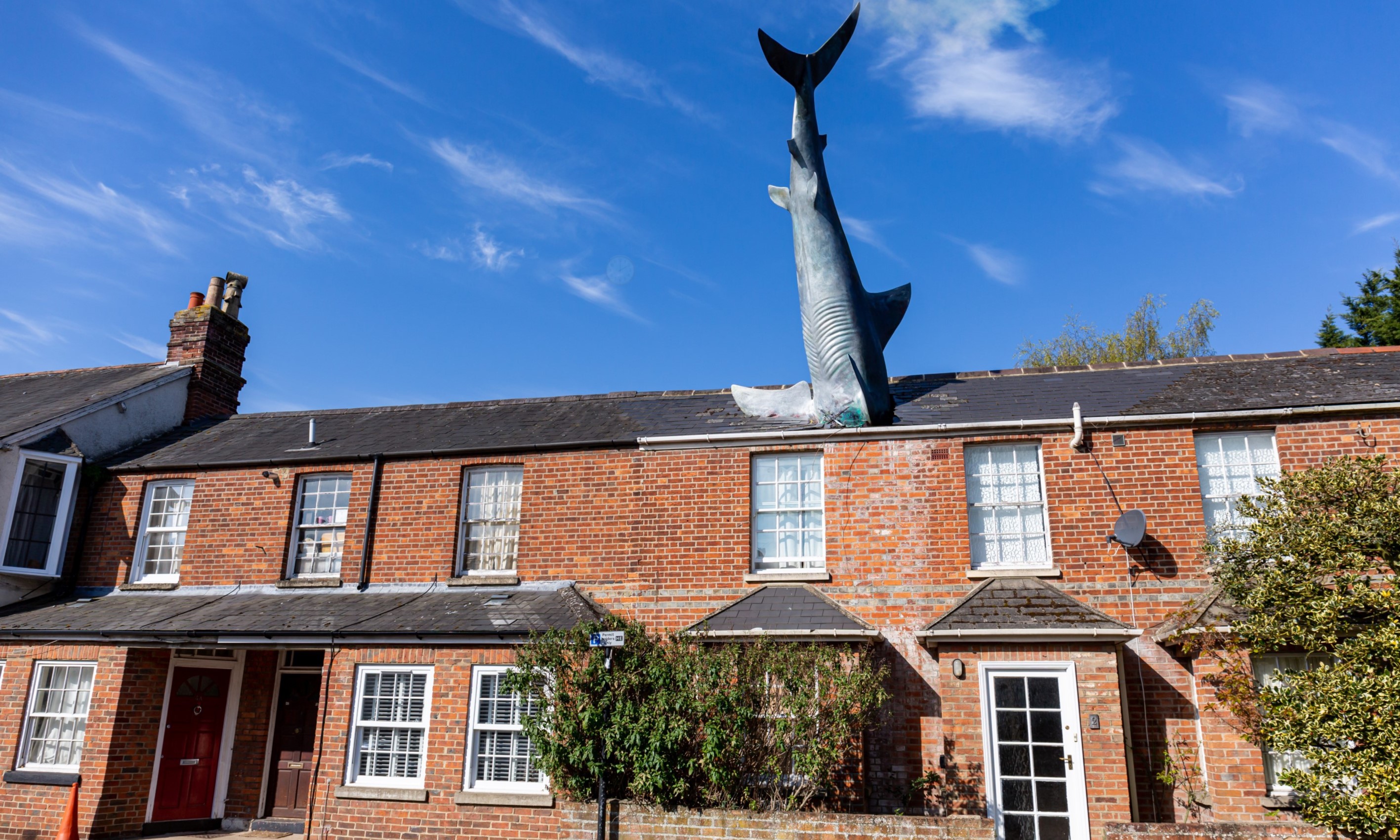
On the morning of 9 August 1986, the residents of New High Street woke to find that something unusual had happened overnight at Number 2. Protruding from the rooftiles, tailfin pointing skyward, was the rear end of a shark, appearing, for all the world, as though it had fallen from the sky and buried itself headfirst in this modest terraced home. Which, in a manner of speaking, it had.
It was a 25-foot fibreglass shark, of course, and the man responsible was Bill Heine – not a Headington native, but by every other measure, he became an adopted Headingtonian. Born in Batavia, Illinois, in 1945, he had come to Oxford to study for a postgraduate degree in Law at Balliol College and, like so many before him, he simply never left. He settled in Headington, running two of Oxford’s most characterful independent cinemas – the Penultimate Picture Palace (which became the Ultimate Picture Palace as we know and love it today!), and the ‘Not the Moulin Rouge’, directly opposite his house on New High Street. In 1988, he became a much-loved presenter on BBC Radio Oxford, where his Sunday morning show made him one of the most recognisable voices in the county.
The shark was conceived as a work of protest art. Heine had it installed in the small hours of that Saturday morning – winched into place by crane, with the police aware but powerless, since no law prevents a man from putting a shark on his own roof. He did so on the 41st anniversary of the atomic bomb being dropped on Nagasaki. The sculpture, which is formally titled Untitled 1986, was created by local sculptor John Buckley, and was intended, in Heine’s own words, to express “someone feeling totally impotent and ripping a hole in their roof out of a sense of impotence and anger and desperation” – a visceral commentary on nuclear power, Chernobyl and the ever-present threat of war from above.
Oxford City Council, displaying a predictably limited appetite for such horseplay, promptly issued an enforcement order demanding its removal.
What followed was a six-year planning battle of increasingly magnificent absurdity, during which the council variously cited safety concerns and the absence of planning permission, at one point even offering to relocate the shark to the local swimming pool. It was a compromise that Heine declined.
In 1992, the Secretary of State for the Environment ruled in Heine’s favour, and the shark was allowed to stay. Bernard Levin, writing in The Times, observed with some relish that the council had sought to remove something “delightful, innocent, fresh and amusing – all qualities abhorred by such committees.”
Bill Heine died in April 2019, aged 74. Surely, then, the council would at last be able to move to remove what they considered to be such an eyesore?
But no. The shark remains.
In 2022, the council that had spent years trying to tear it down added it to Oxford’s official list of heritage assets – a decision that prompted his son Magnus to note, with some justification, that “using the planning apparatus to preserve a historical symbol of planning law defiance is absurd.”
The shark, it seems, still has bite. Look up as you pass Number 2 on New High Street (well, you can hardly miss it): there it is, in all its defiant glory, as improbable and idiosyncratic as the day it arrived.
***
C. S. Lewis: The Professor Who Found a Lion and a Witch in a Headington Wardrobe
Of all the remarkable people who have called Headington home, perhaps none has left a deeper mark on the wider world than Clive Staples Lewis, someone known to his friends, if not always to history, simply as Jack.
The Belfast-born and raised man we all know best as C. S. Lewis, who became an Oxford University student and then a Fellow and Tutor of English Literature at Magdalen College, first set eyes on The Kilns, a rambling bungalow set in eight acres off Kiln Lane in Risinghurst, on a Sunday afternoon in July 1930.
His brother Warren, who was to buy (or at least live in) this property with him, wrote in his diary the following day that although he hadn't yet gone inside, "the eight-acre garden is such stuff as dreams are made of."
From an estate agent’s point of view, talk about first impressions being made to count.
He moved in that October with his brother and his companion, Mrs Janie Moore, and The Kilns would remain his home until his death more than three decades later.
In those years, Lewis transformed from a respected Oxford don into one of the most widely read authors of the twentieth century. It was here, at his desk in Risinghurst, that he wrote the seven books of The Chronicles of Narnia. The landscape around him – the lake in the old clay pit behind the house, the woodland, the nearby countryside of Shotover Hill – seeped directly into those pages in ways that readers still feel today. Most don’t know where they can find Narnia. But in Headington, we’re lucky; we can visit it ourselves. Lewis gradually bought up more of the land surrounding his home at The Kilns over time and eventually donated 12 acres of its woodland as a public nature reserve, which is today managed by BBOWT – Berkshire, Buckinghamshire and Oxfordshire Wildlife Trust.
Lewis was one of the great Christian apologists of his era. For over thirty years, he worshipped at Holy Trinity Church in Headington Quarry, a short walk from The Kilns. He died on 22 November 1963, which means that his death was almost entirely eclipsed in the news, for President Kennedy was assassinated that very same day. He was buried in the churchyard at Holy Trinity Church, and his grave remains a destination for Narnia-loving pilgrims to this day.
The Kilns itself still stands, now in ‘Lewis Close’, Risinghurst, operated by the C. S. Lewis Foundation as a study centre for scholars. Tours are available by appointment on Tuesdays, Thursdays and Saturdays, and for any admirer of Lewis, standing in the rooms where Narnia was born has got to be a must-do.
***
A Cast of Many
Lewis, Heine and Joan of Headington are notable standouts, but Headington's local roll call of remarkable residents could fill several pages. Here’s a further brief selection in case you fancy doing a bit more discovery of your own:
Joan Clarke, the brilliant mathematician who cracked the Naval Enigma code at Bletchley Park alongside Alan Turing – and to whom Turing was briefly engaged – spent her final years at 7 Larkfields in Headington Quarry, attending the same Holy Trinity Church that Lewis had loved. She died there in 1996.
Sir Isaiah Berlin, the philosopher and celebrated defender of liberal values, lived at Headington House on Old High Street.
Robert Maxwell, the publisher and proprietor, once-owner of Oxford United Football Club – and a man not unacquainted with controversy – took a long lease on the magnificent Headington Hill Hall from Oxford City Council. He was known to describe it as "the best council house in the country."
Brian Aldiss, one of Britain's most important science fiction writers, lived in Old Headington until his death in 2017.
Still the Hill
Headington today is many things at once: a medical and academic hub, a residential suburb, a place of green spaces and settled family life. But beneath it all runs the long thread of a history that most of its residents can walk past daily without knowing.
So, the next time you climb Headington Hill, consider what the Romans thought when they looked out from their pottery works across the Thames valley. Think about Joan, presiding over her alehouse with that magnificent self-possession. Of Clive Staples Lewis, walking down to Quarry for church on a winter’s morning, already turning the landscape into something mythical in his mind. Think about a normal English street of terraced houses, and a huge shark sticking out of the roof of one of them.
Headington: there is far more to it than meets the eye.
